Monday, May 13, 2013

GPS Contest 2013

That was pretty fun wasn't it? I enjoyed watching each team in action on Friday. The weather was awesome. So many of the groups did very well, and every one of the film canisters was found...... eventually. I commend all the teams for their hard work. Here are the results from the 2013 GPS Contest: GPS Final Standings 2013
Period 3: The Super Trendy Diapers narrowly edged out the Oreos to claim victory.
Period 4: Great People got the top spot, followed by the Jolly Space Ranchers.
Period 6: The Steampunks ran away with the contest, beating TMEK by 6 points.
Period 8: MAKS was victorious, but MG wasn't too far behind. Both teams had impressive point totals.

Feel free to leave comments that you have about the GPS contest. How was your experience? Were there any waypoints that you just couldn't seem to find? What was the best strategy? If you had to do the contest again, what would you change?

Thursday, April 18, 2013

SSoCC Evaluation and Reflection


Well, the Socratic Seminar on Climate Change came and went. Hopefully you were able to share your knowledge and point-of-view on this subject with your classmates. I say this because your opinion/knowledge matters. A lot.
Below is a link to your partner evaluation and your own reflection on the discussion we just had (and the research that led to it). Please include anything you might have wanted to say, but did not get the chance to. Show me what you know about Climate Change. Thanks.

Partner Eval and Reflection Form

Monday, April 15, 2013

Socratic Seminar on Climate Change Research


Is "global warming" actually happening? If so, are humans causing it? Or, is climate change occurring because of natural fluctuations in the system? We will be discussing these questions and more in our Socratic Seminar on Climate Change, which will occur during class on Wednesday. In between now and then, you will be preparing yourself to contribute (intelligently!) to that discussion. I will give you a list of questions that will be addressed, and you may use the links provided to research the issue of climate change. Remember to have an open mind, so that your arguments will be well-informed.

The list of questions that may be discussed is on your paper packet, and they are also posted here: Google Doc; Word Document). Feel free to write notes on it as you research. You may use these notes during the discussion.

Here is the list of links:

EPA for Kids (click on the "Climate Change -- what it is" and "Can we change the climate?")

Thursday, March 21, 2013

World's Deepest Trenches

Check out this link that helps you explore ocean trenches. What's the most interesting thing that you saw? Would you want to be the next person to go down to the Mariana Trench? Why? Why not?
Ocean Trench: Take a dive 11,000 m down

If you have the time, also check out these videos from National Geographic about plans to once again go to the Mariana Trench.

Monday, March 11, 2013

Coke Challenge

Don't let the title of this post fool you. This is not a taste test. Instead, we will test these objects' densities. Please follow the directions that are given below the slideshow.
Coke vs. Diet Coke Density

  • Click on "comments". Like always, this will open up a new window where you may type your blog response.
  • Advance to the next slide by clicking on the right portion of the slideshow. You can also click on the left portion if you want to go back to the previous slide.
  • In your blog response, answer all questions that appear on the purple-ish slides.
  • Do not advance to the next slide until you have completely answered the questions that appeared on the purple-ish slides.

Tuesday, February 26, 2013

The Power of Solar Activity

If you think that campfires are mesmerizing, watch this video and then wonder where four minutes went.

Other Cool Solar Activity Videos:
Coronal Mass Ejection in HD
Live Solar Flare
The Auroras video
Southern Lights from the ISS

This article and associated pictures show some of the effect of Solar Activity as we approach the next Solar Maximum. This Space Weather Dangers Article warns us of the damage that massive flares from the sun could cause. Read these. In a comment, share one effect that Solar Weather could cause and one thing you just found interesting.

Sun Sites

Do a quick search through the following websites for 8 minutes.

Characteristics of the Sun
3D Solar System Tour
Sun-Earth Viewer
Amazing Photos of the Sun

What is the most interesting fact that you found about the sun and its size? Leave it in a comment on this post.

Thursday, February 7, 2013

Remember the Tides


Using these pictures and the following info, attempt to answer the numbered questions.
  • Both pictures were taken from the same exact spot (The zoom for both snapshots was the same, too). The picture on the left was taken at about 2 o'clock in the afternoon. The picture on the right was taken 5 1/2 hours later, at 7:30 pm.
  • The high temperature on this day in Puerto Vallarta, Mexico was about 85 degrees F. I tell you this not because daytime temperature influences tides. I tell you this so that might be jealous, and that you might be reminded that this snowy, frigid winter will not last forever.
  • The moon phase on this particular day was a "New Moon".
  1. What causes high tides and low tides?
  2. Approximately how many high tides would there be on this day? How many low tides would there be?
  3. On the day when the picture was taken, was there a Spring or Neap tide? If so, which one? How do you know this? ****Alert: This question is impossible to answer correctly with the information given. 
    • New Questions: What makes it impossible? What, from the information given, could you change to make it answerable?

Wednesday, January 23, 2013

Explaining Astronomy to Elsie


Suppose that you need to explain the concepts of a year, a month, and a day to a small child such as Elsie. Could you do this? First, you should know a couple of things about Elsie:
  1. She is extremely smart for just turning four years old (I know that you're thinking, "Hmm..... she must get her intellect from her mother." Well, you're right.) Elsie will follow your line of thought quite well.
  2. If you use the terms rotation, revolution, orbit, or any other term used specifically for astronomy, she might not know exactly what it means (Many adults wouldn't know what the terms mean either.) Be sure to explain these things as you go.
  3. It would help if you related these concepts to things a 4-year-old would know about -- like Disney movies (especially Rapunzel from Tangled and, of course, Cinderella), Elmo from Sesame Street, Legos, Clifford the big red dog, Super Why, Angelina Ballerina, etc.
For each concept (year, month, and day) describe the motion of the Earth, the moon, and the sun. Good luck.

Friday, January 11, 2013

Planet Presentations 2013

Comment: I eagerly await the chance to become an expert on each of the planets of our solar system.
Question: Who is going to give me that opportunity?
Answer: The Mustang 8s
Another Question: How?
Another Answer: They will be researching a specific planet, collaborating in groups, and developing a presentation that will blow away (in a good way) anyone who is fortunate to be in attendance.

Below is a link for some useful planet research sites.

Planet Presentation Links and Instructions

Thursday, January 3, 2013

The Growth Mindset

We've talked about character traits (like grit, optimism, self-control, etc.) that lead to success. It can be extremely difficult to improve those traits if you don't think they are modifiable. That's what this video is about. Simply having the mindset that you can improve and "get better" is vital to actual growth.
Growth Mindset TED Video
What is the thing you take away from this video?

Wednesday, December 12, 2012

Locate the Earthquake

Problem: Where is the earthquake’s epicenter, and when did it happen?
Information: P Waves travel an average of 5000 m/s through North America. S Waves travel an average of 3000 m/s. You also have a record of earthquake activity from five different seismograph stations throughout the United States. The seismograms are visible on this map. (Open these seismograms in a new tab in order to get a good look - you will have to right-click on the seismogram to do this.)
View Locate the Earthquake in a larger map

After you figure out how far each station is away from the epicenter, use this mapping tool. It will allow you to draw measured circles around different locations to pinpoint this earthquake’s epicenter. Good luck!

In your comment below, answer these simple questions:
  1. Where did this earthquake happen? (Where was the epicenter?)
  2. When did this earthquake happen? (answer to the nearest second)
  3. How did you figure it out?
Prizes for figuring out the answers to this problem include the following:
  • 3 Bonus points on your Earthquakes Standard Check
  • Mike & Ike's with Mr. Hoegh
  • One game of H-O-R-S-E with Mr. Hoegh
  • A Homemade Christmas Card from Mr. Hoegh's daughters
  • One game of catch (football, baseball, softball, or frisbee) with Mr. Hoegh
  • 15 Minutes of Pepper (volleyball) with Mr. Hoegh
  • 2 Karaoke Songs by (or with) Mr. Hoegh

Tuesday, December 11, 2012

Earthquake Sampler

Earthquakes have had quite an impact on our society in the past, and they will continue to have that Earth-shattering (literally!) impact in the future. It is highly unlikely that any of us have physically experienced one of these natural disasters, and I hope that none of us ever will. What do you think it would be like to experience a Great Quake? What would you do? How would you feel about the total loss of control in the situation? You will learn about some of the Great Quakes in history. Through first-hand accounts of people who were fortunate to live through a large earthquake, you will get a chance to learn about what it was like to experience one of these historical natural disasters. The details for today's activity are found HERE.

In your blog response, remember to answer TWO of the three choices. As always, I look forward to reading what is written!
a. What was the most memorable story, image, or fact about the earthquake you researched? Why?
b. What do you think it was like to live through the earthquake you researched?
c. Have you ever experienced another natural disaster, such as a tornado, hurricane, severe thunderstorm, or flood? Create your own personal recollection of living through the destruction that event caused.

Monday, November 26, 2012

Identifying Minerals

In the past few days in science, your view of minerals has likely changed. You've discovered that there are many different classes/types of minerals -- each with a unique set of properties that allows us to identify one mineral from another.
In your comment, completely answer the following questions. If you don't want your comment to be published, that is fine! Just let me know in the comment you leave.
  1. Minerals are identified by their properties. What are some of the properties you used to distinguish one mineral from another? Why is it best to use more than just one or two of these properties?
  2. Did some of the properties "work" better than others? Which ones were the most effective? Which were the least effective? Explain.
  3. What was the most difficult part of identifying minerals?
  4. How many minerals (of the 17) did you identify correctly?

Monday, October 29, 2012

The Geology of the Black Hills

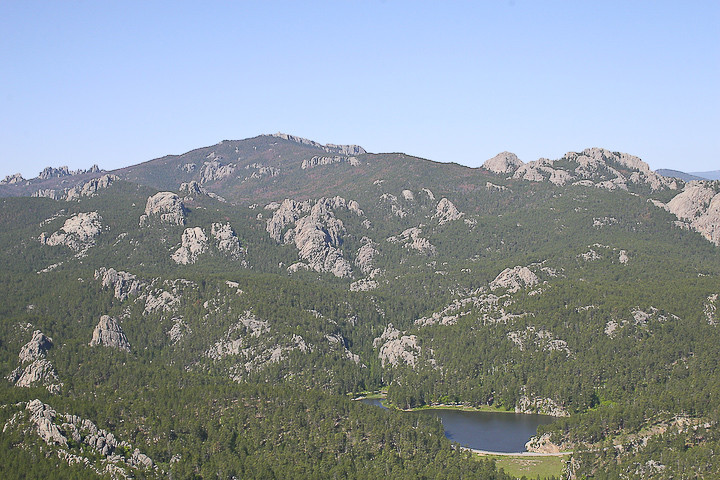
Image Courtesy of Beth Steinhauer, Black Hills National Forest
(Forest Service of US Department of Agriculture) under Public Domain
Many of you have been out to the Black Hills. If you haven't (or if you can't remember what it is like), visualize the following scenario:
As you drive west from Rapid City, you notice a jagged stretch of sandstone peaks called the Hogback Ridge. After a short descent from those sandtone peaks, you come to an area comprised of another sedimentary rock, red shale, which makes a "Racetrack" around the Black Hills. If you keep driving west, there is a gradual incline made of limestone. This limestone formed 100-500 million years ago, from the shells of ancient marine animals. (Yes, we are still in the Black Hills of South Dakota.) Keep driving still, past this limestone plateau, and you will see the Central Crystalline Core of the Black Hills. This area is made of schist (a metamorphic rock) and granite (an intrusive igneous rock) that have aged for up to 2.5 billion years. The apparent color of this Central Core and the groves of Ponderosa Pine gave this area its name, the Black Hills. You might want to get out of the car and take a hike up to Harney Peak, the highest peak in between the Rocky Mountains and the Alps of Switzerland.
What are the events that led to the formation of these Black Hills? Why does it look the way it does? Like geologists, we will explore these questions today.

  1. Write a summary of how the Black Hills formed. What are the events that led to their formation?
  2. Would the Badlands exist if weathering/erosion had not taken place? Why/Why not?
  3. The major uplift of the Black Hills occurred 70 million years ago. What do you think that area of South Dakota looked like 40 million years ago? What do you think the Black Hills and Badlands will look like in another 40 million years?

Wednesday, October 24, 2012

Yosemite National Park

This quarter we will begin to learn about Geology; mainly how the Earth has changed in the past, and about the forces that continue to change our planet's landscape. The video below is one of my favorites. Check it out. I suggest you watch it fullscreen with high volume. A bunch of questions pop into my head as I watch it. Do you have any? As you watch the Yosemite National Park video, leave any questions/comments that you have in a blog comment.
Yosemite HD from Project Yosemite on Vimeo.