Thursday, November 1, 2012

Monday, October 29, 2012
The Geology of the Black Hills
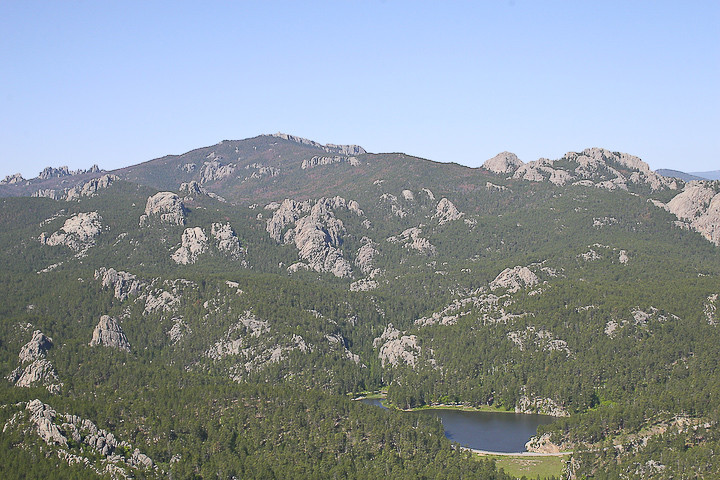 |
| Image Courtesy of Beth Steinhauer, Black Hills National Forest (Forest Service of US Department of Agriculture) under Public Domain |
As you drive west from Rapid City, you notice a jagged stretch of sandstone peaks called the Hogback Ridge. After a short descent from those sandtone peaks, you come to an area comprised of another sedimentary rock, red shale, which makes a "Racetrack" around the Black Hills. If you keep driving west, there is a gradual incline made of limestone. This limestone formed 100-500 million years ago, from the shells of ancient marine animals. (Yes, we are still in the Black Hills of South Dakota.) Keep driving still, past this limestone plateau, and you will see the Central Crystalline Core of the Black Hills. This area is made of schist (a metamorphic rock) and granite (an intrusive igneous rock) that have aged for up to 2.5 billion years. The apparent color of this Central Core and the groves of Ponderosa Pine gave this area its name, the Black Hills. You might want to get out of the car and take a hike up to Harney Peak, the highest peak in between the Rocky Mountains and the Alps of Switzerland.
What are the events that led to the formation of these Black Hills? Why does it look the way it does? Like geologists, we will explore these questions today.
- Write a summary of how the Black Hills formed. What are the events that led to their formation?
- Would the Badlands exist if weathering/erosion had not taken place? Why/Why not?
- The major uplift of the Black Hills occurred 70 million years ago. What do you think that area of South Dakota looked like 40 million years ago? What do you think the Black Hills and Badlands will look like in another 40 million years?
Wednesday, October 24, 2012
Yosemite National Park
This quarter we will begin to learn about Geology; mainly how the Earth has changed in the past, and about the forces that continue to change our planet's landscape. The video below is one of my favorites. Check it out. I suggest you watch it fullscreen with high volume. A bunch of questions pop into my head as I watch it. Do you have any? As you watch the Yosemite National Park video, leave any questions/comments that you have in a blog comment.
Yosemite HD from Project Yosemite on Vimeo.
Yosemite HD from Project Yosemite on Vimeo.
Tuesday, October 16, 2012

Wednesday, October 10, 2012
Distillation Demo


After making observations of the Distillation demo, write a description of how it works. Use terms like vaporization, condensation, condensing tube, distillate, and thermometer to aid your recollection of what happens during the distillation process.

Tuesday, October 2, 2012
Static Electricity
Below is a picture of Clara (about 4 years ago). She briefly turned her soccer goal into a fort/tent with a blanket on top, and (as you can see) some serious static electricity was produced!

After watching the demos AND contemplating some of your own experiences with static electricity, answer the following questions in a comment on this blog post:

After watching the demos AND contemplating some of your own experiences with static electricity, answer the following questions in a comment on this blog post:
- What was your favorite static electricity demo? Why?
- What time of the year do you get "shocked" the most often? Why is that?
- What is needed to produce static electricity? What is it caused by?
- What does static electricity have to do with chemistry, atoms, and an atom's structure?
Monday, October 1, 2012
Atomic Model throughout History
Check it out. It's our class Google Map of the scientists and events that have impacted our view of the atom the most.
View Atomic Model throughout History in a larger map
View Atomic Model throughout History in a larger map
Subscribe to:
Posts (Atom)